Goal Setting in the New Year: What Really Works
Each year, about 30% of Americans begin January with a resolution and a renewed sense of possibility. Whether the goal is better health, more connection, or less screen time, the real challenge isn’t setting goals – it’s sustaining them.
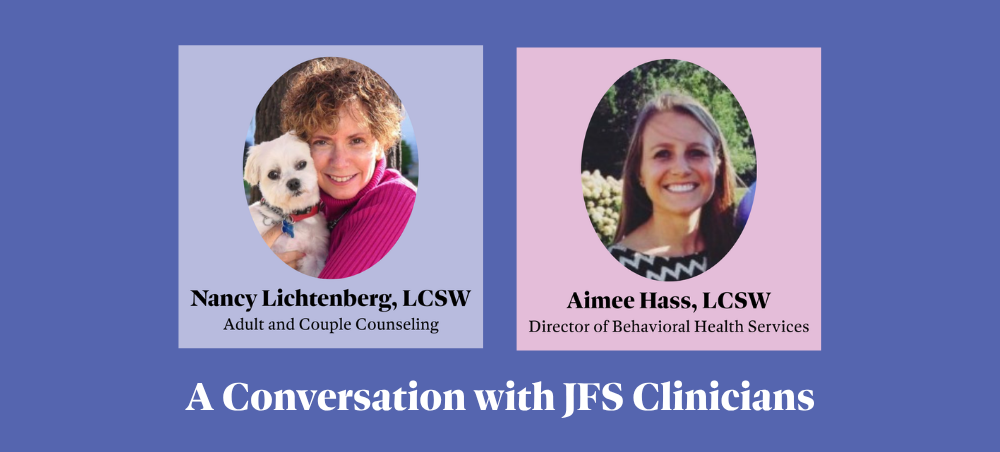
Below, JFS clinicians Nancy Lichtenberg, LCSW, and Aimee Hass, LCSW, share practical, compassionate insights into what helps change last, well beyond January.
When people set New Year’s resolutions, where do you think real change begins?
NANCY: I tend to push back on setting intentions, or New Year’s resolutions, and find it more helpful to spend time reflecting on the previous year before deciding what’s next in the coming year. This is a great place to start.
AIMEE: Real change begins when you are able to self-reflect and identify small achievable goals, instead of large broad ones. This shifts “I will work out more” to “I commit to walking around my neighborhood for 30 minutes a day, three times per week.”
When people want change that lasts beyond January, what do you believe actually works?
NANCY: What really works is deepening your connection to yourself. Whatever has helped someone deepen their connection to themselves in 2025 should come with them into 2026. To really dig into this, I might ask a client questions like, “Is there something that you learned about yourself in 2025 that you’re glad to know, even if getting there was a little painful?” or “Who or what helped you to grow in 2025 and how will you take these lessons with you into 2026?”
AIMEE: All positive change begins with a solid plan. You can start with a larger goal, then outline smaller action steps that will help you achieve it. This strategy is very effective, but requires constant evaluation and a healthy dose of self-compassion. Always remember that one small setback does not need to derail your larger goal.
How can people recognize what’s worth carrying with them into a new year?
NANCY: When clients come to therapy, they’re usually not focused on typical resolutions like exercising more or eating better – they’re seeking peace and tranquility. Anything that helps someone feel grounded and calm, without harming their health, safety, or relationships, is worth carrying into the new year. Often, finding calm doesn’t require drastic change. It may be less about changing routines and more about what’s happening internally – our mindset, self-perception, or ability to live in the moment and accept change.
AIMEE: Figure out what is bringing you energy – not just results. Some things succeed on paper and look like “wins” but quietly drain you. Be sure the people you surround yourself with align with your goals and the person you might be growing into. It is okay to let go of relationships that no longer serve a purpose. And most importantly, listen to your body and your emotions to ensure your overall wellbeing is being supported.
For people who didn’t set resolutions – or who feel discouraged by them – what would you want them to know as the year unfolds?
NANCY: Resolutions can sometimes feel like just another item on an already long to-do list. Instead of focusing on small, rigid goals, it can help to step back and think more broadly. Our bodies do so much for us automatically and without our control. I would recommend people go into the new year looking at their feet, wiggling their toes, and appreciating the miracle that our brains can make our toes wiggle. Shortening to-do lists or dialing back expectations can help us to realize not everything is in our control, and life is generally better when we recognize this.
AIMEE: There is nothing wrong with skipping resolutions. It doesn’t mean you lack motivation, discipline, or hope; it might just mean you are tired of promising change in ways that don’t work for you. Growth is not seasonal – it’s responsive. You can begin on a random Tuesday in April just as meaningfully as on January 1st. It’s also worth knowing that you are allowed to want less this year – less pressure, less self-criticism, less proving. Sometimes choosing what to protect is more transformative than choosing what to achieve.